Anthony Brown
Cartes Postales from GreeceAnthony Brown is both the absent sender whose postcards set Ellie Thomas’s journey in motion and the man she eventually meets in Athens, carrying the battered blue notebook that holds the story of his heartbreak. His arc links a private loss to an unexpected friendship: the pages he has written reach Ellie by mistake, and their return creates a practical opening for her to remain in Greece.
Identity and Introduction
For much of Ellie’s early journey, Anthony exists only indirectly: in postcards of Greece signed with the single letter A, and in a blue notebook that was not addressed to her. The cards gradually become more than images pinned to her corkboard. As their succession suggests a journey through Greece, Ellie begins marking their locations in an atlas and falls in love with a country she has not yet visited. The cards cannot be returned to their sender because his identity is unknown; the name S. Ibbotson appears as their intended recipient, but no further mail reaches that person.
Anthony’s identity becomes traceable when Ellie discovers an address on the envelope that has held the notebook: 389 Aristophanous Street, Athens 11281. On the last night of her holiday, she hesitates over whether to seek him out. Doing so would mean admitting that S. Ibbotson never received the postcards and that Ellie had opened a package not meant for her. She eventually goes to the address. When the lift doors open, Anthony notices the notebook before he looks at her face. His immediate shock makes clear that the worn blue object is personally important to him.
The Postcards and the Notebook
The postcards give Anthony a presence in Ellie’s life before she knows his name. Their recurring images—blue skies and sea, boats, and whitewashed buildings with blue shutters—form a colourful mosaic on her corkboard. The cards also insist on what pictures cannot provide: they offer only a glimpse of Greece, not its sounds or scents. Yet that incomplete view is powerful enough to change Ellie’s sense of possibility. When the postcards stop arriving, the silence sharpens her longing; she wonders whether the Greece they depict is real and books a trip.
The notebook extends that indirect communication. By the time Ellie meets Anthony, she has read its stories, and he understands that she has encountered what he calls the most important things. The contents give her a view of his relationship with Sarah, while their physical condition—the battered blue cover—gives the revelation a concrete object to turn around. For Anthony, it is not merely a manuscript: his first response is to ask where Ellie got it. For Ellie, returning it requires crossing the boundary between reading another person’s private account and meeting its author.
Sarah Ibbotson and the Broken Relationship
Anthony begins the account of his relationship with Sarah at the Curzon bar in Mayfair. He had been sitting alone because the person he was supposed to meet had not turned up, and was passing time before a film by the Greek director Lanthimos. He says he does not usually approach strangers; Sarah spoke to him first. Their conversation turned to Greece, which she had visited as a child on a yacht belonging to her parents’ friends, although she had seen only a few islands.
Anthony describes himself as having mistaken love’s idealized side for the whole of it. In his account, his musings on Eros and Psyche had kept him from attending to the betrayals and tragedies that love can involve; he had not wanted to think about endings. He recognizes that, despite an age difference of fifteen years, he was the more childlike of the two. The admission is a measure of hindsight: he can now name the immaturity in his attachment, even as the relationship’s failure remains consequential.
For a time he held on to a ring he had bought for Sarah. Only shortly before meeting Ellie, he summoned the courage to return it. The money from the ring would cover a year’s rent, making the gesture humiliating but materially useful. He also hoped that new legislation would allow him to remain where he was for at least that long. The ring’s return thus marks more than the relinquishing of a romantic token: its value becomes a means of meeting the immediate costs of continuing his life.
Work, Encounter, and What Follows
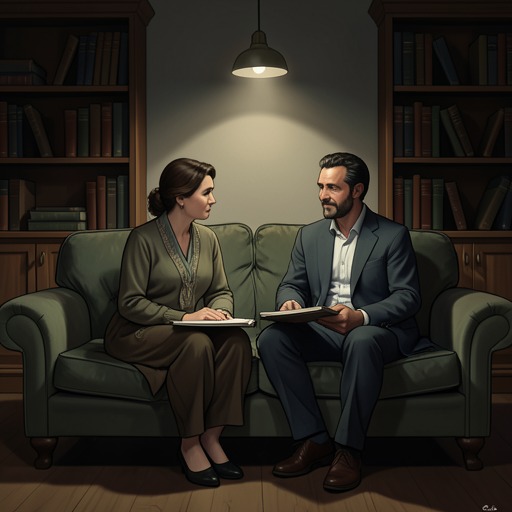
At their first meeting, Anthony is described as very slim, with thick brown hair and a few wisps of grey, wearing jeans and a grey T-shirt. His appearance is secondary to the notebook in his hands—or, more precisely, the notebook Ellie holds. Recognizing it, he asks where she found it, and their conversation proceeds from the fact that she has read his writing. The encounter turns an accidental passage of private words into a face-to-face exchange.
Anthony still writes by hand, explaining that he and others of his generation missed the computer age. His difficulty is not a lack of writing but the practical problem that his publisher cannot read his handwriting. He needs someone to type his manuscript. Ellie says she can do it, having had no trouble reading the stories, and Anthony offers her the job. He also offers her his spare room if she has nowhere else to stay.
The offer meets Ellie at a turning point. Her habit tells her to return to London, where family and friends expect her, but she feels drawn to stay. Anthony’s proposal does not erase the loss revealed in his notebook, nor does the evidence establish that their relationship becomes romantic. Its importance lies instead in the concrete opportunity it creates: paid work and accommodation, offered by the person whose writing first helped bring Ellie to Greece. Through the postcards, notebook, and final offer, Anthony’s private story becomes the means by which an unintended reader finds a possible future of her own.